
from Sarah Zimmermann
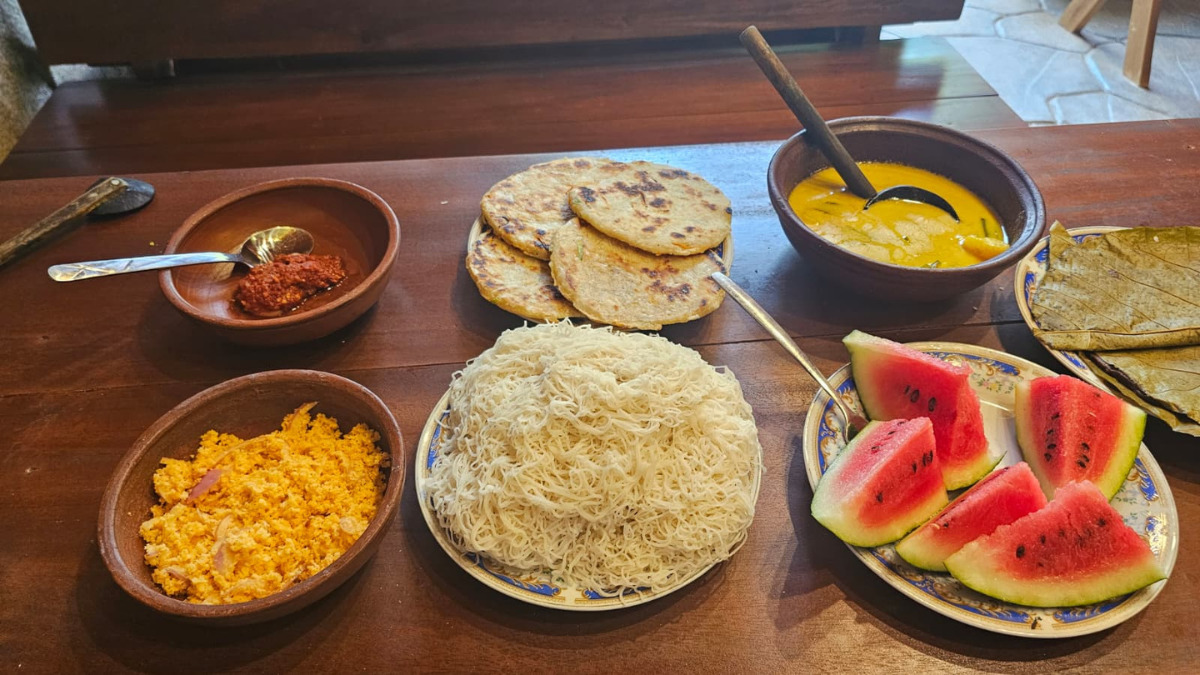
An island where countless spices, flavours and cultures come together. Where food is not just food, but an important part of everyday life and culture.
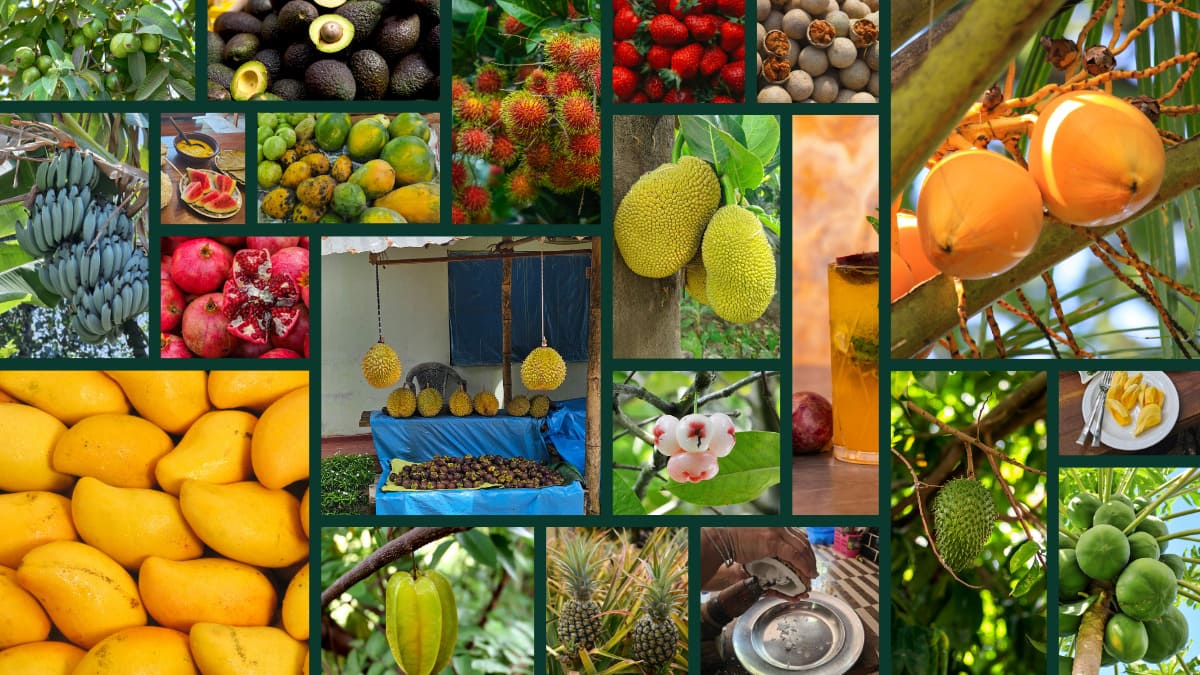
Sri Lanka is known for its incredibly diverse cuisine: tropical fruits, all kinds of vegetables, flavourful curries, hoppers, kottu, sweet treats, rice and curry and so much more.
But what is it actually like if you are vegan?
How easy is it really to eat vegan in Sri Lanka?
First things first: I have travelled to quite a few countries. In some, it was incredibly easy to find vegan restaurants and alternatives. In others, the search could be pretty difficult and sometimes even frustrating.
Sri Lanka, on the other hand, felt surprisingly easy from the very beginning.
One reason is that many traditional Sri Lankan dishes are already plant based or can easily be ordered vegan. Coconut milk, grated coconut, rice, lentils, vegetables and plenty of spices form the base of many dishes.
Still, there are a few things you definitely need to look out for. Especially if you are not only vegan, but also need to strictly avoid certain ingredients because of an allergy or intolerance.
Traditional Sri Lankan dishes that can be vegan
One of the best things about Sri Lankan cuisine is that many dishes do not even need to be "veganised". Plant based ingredients have always been a natural part of traditional Sri Lankan cooking.
That said, recipes can vary depending on the restaurant, family and region. If you are unsure, it is always better to ask one more time.
String Hoppers
String hoppers are thin rice noodles that are pressed into small nests and then steamed. They are often eaten for breakfast or dinner and served with different curries and sambols.
String hoppers themselves are usually plant based. With the side dishes, however, it is worth taking a closer look.
Hoppers
Hoppers are definitely one of those things you should try when you are in Sri Lanka. These crispy, bowl shaped pancakes are traditionally made from a fermented batter based on rice flour and coconut milk.
Plain hoppers can be vegan. With egg hoppers, of course, there is no question. 😉 If you are unsure about the batter, it is best to quickly ask.
Parippu / Dhal Curry
Lentils, spices and often coconut milk: dhal, or lentil curry, is one of the classics of Sri Lankan cuisine for me and one of the easiest plant based options.
Dhal is basically an everyday food here. You might have it for breakfast with coconut roti, with paratha, for lunch as part of rice and curry or for dinner with pittu. It goes with so many different dishes and is simply an essential part of Sri Lankan cuisine.
Pol Sambol
Pol sambol is mainly made from freshly grated coconut, chilli, onion, lime and spices and is eaten with all kinds of different dishes, such as pol roti, string hoppers and many more.
But be careful: some versions contain Maldive fish, which is dried fish. More on that later.
Coconut Roti / Pol Roti
Roti is made from flour and grated coconut, and depending on the recipe, onion, curry leaves and green chillies may also be added. It is eaten for breakfast or dinner with sambol or curries.
One thing you should also be aware of is that pol roti is often served with pork curry. Among Sinhalese, eating pol roti with Kalu Pol Pork is a traditional combination.
Vadai / Wade
You can find these fried snacks made from lentils, onion, chilli and spices in many places around Sri Lanka. They are especially great as a quick snack when you are out and about.
Rice and Curry
Rice and curry is probably one of the easiest meals to choose if you want to eat vegan in Sri Lanka.
Rice is served with several different curries and side dishes. If you order a vegetable version, you can quickly end up with a whole plate full of different plant based dishes.
But there is one small thing to watch out for here too: dried fish.
It is best to ask specifically whether Maldive fish or any other dried fish has been used in the curries or sambols.
Vegetable Kottu
Of course, kottu also belongs on any Sri Lanka food list.
Roti is chopped into small pieces and cooked on a hot griddle together with vegetables, spices and other ingredients.
Important: Vegetable does not automatically mean vegan.
Vegetable kottu is very often prepared with egg. So make sure to order it "without egg" and, if necessary, ask about butter or margarine too.
Vegetable Fried Rice and Noodles
You can find fried rice and noodles practically everywhere, and they can usually be ordered with vegetables without any problem.
But the same rule applies here: order them without egg.
It is also worth asking whether butter, margarine or any other animal based ingredients are used.
Kiribath
Kiribath translates to milk rice and is made with rice and coconut milk. It is a traditional dish that is also eaten on special occasions in Sri Lanka. Kiribath is usually eaten for breakfast with sambol.
Because it is made with coconut milk, kiribath can be completely plant based. If you are buying it ready made or ordering it in a restaurant, I would still quickly ask.
Pittu
Pittu is made from rice flour and coconut and then steamed. It is often served with curries or coconut milk.
Again, the main thing to pay attention to is what it is served with.
Pani Pol / Sri Lankan Pancakes
These sweet pancakes filled with coconut are usually vegan. However, sometimes the batter can contain egg or regular milk.
This is more likely to happen in restaurants. In local shops, you will usually find a vegan version, as eggs and milk are relatively expensive in Sri Lanka.
What should you look out for when ordering?
Traditional Sri Lankan cuisine makes eating vegan pretty easy in many ways. Still, there are a few ingredients that like to hide in places where you might not expect them.
Just because the menu says Vegetable Kottu, Vegetable Fried Rice or Vegetable Noodles, it does not mean the dish is vegan.
Egg is used very often here.
That is why I prefer to say it clearly when ordering:
No egg, please.
Ghee, butter and margarine
Especially if you are eating at an Indian restaurant, you should ask about ghee.
Ghee is clarified butter and therefore not vegan.
You should also be careful with margarine. Unlike what you might expect, margarine in Sri Lanka is not automatically plant based. Many products contain dairy ingredients or milk solids.
If you need to avoid milk because of an intolerance or allergy, I would therefore not only ask about butter, but mention margarine as well.
Be careful with Maldive fish and dried fish
This was probably the thing that surprised me most in the beginning.
Dried fish, especially Maldive fish, is sometimes used in curries, sambols and other dishes as a flavouring ingredient.
This means that a dish can look completely plant based at first and still contain fish.
Especially with pol sambol and different vegetable curries, I would always ask specifically:
Does this contain Maldive fish or dried fish?
Do not rely solely on a dish being described as "vegetable". We have had this experience particularly often around Galle, where dried fish is commonly used in curries.
Coconut milk is your best friend
One thing that makes everything much easier is that coconut milk is simply a big part of Sri Lankan cuisine.
Many curries get their creaminess from coconut milk rather than cow's milk or cream.
And that is one of the reasons why so many traditional dishes can easily be suitable for a vegan diet.
Why vegan food is not that unusual culturally
Sri Lanka is strongly influenced by different religions and cultures. Buddhist and Hindu traditions play an important role, and vegetarian food is widely available.
Of course, that does not mean that all Buddhists or Hindus are vegetarian. Meat and fish are just as much a part of Sri Lankan cuisine.
But one big advantage for vegans is that vegetables, lentils, rice, coconut and plant based curries are a completely normal part of everyday food here.
And that is exactly what I love about it:
You are not constantly eating a vegan substitute for something that was originally not vegan. Many dishes are simply eaten the way they have always been eaten.
Vegan restaurants or local restaurants?
In tourist areas and larger cities, you can now find plenty of restaurants that clearly mark vegetarian and vegan dishes on their menus. There are even some completely vegan restaurants.
Inland or in small local restaurants, things can look a little different.
But that absolutely does not mean you will not find anything vegan there.
Quite the opposite. Often, there are already several curries in front of you that could be plant based. There just might not be a big VEGAN sign next to them. 😉
This is where it is worth asking directly and explaining what you do not eat.
If you need to avoid certain ingredients because of an allergy or intolerance, I would make that very clear as well. In that case, do not rely only on the word "vegan". Name the specific ingredients you cannot have.
Vegan grocery shopping in Sri Lanka: What about vegan alternatives?
While eating vegan in restaurants and enjoying traditional Sri Lankan food can be surprisingly easy, vegan alternatives in supermarkets are a different story.
If you come from Switzerland or another European country and are used to huge supermarket shelves filled with vegan burgers, cold cuts, yoghurt, cheese and other alternatives, you will find considerably less choice in Sri Lanka.
There are alternatives, and some of them are really good.
The main problem is: They are not available everywhere and are often pretty expensive.
Planted based milk
You can find soy, oat and almond milk, especially in larger supermarkets such as Keells and Arpico.
So you definitely do not have to give up your plant based milk completely. However, these products come at a price.
Compared with many local foods, plant based milk in Sri Lanka feels like it costs a small fortune. 😅
If you use a lot of plant based milk every day, you will definitely notice it in your grocery budget.
Vegan butter and margarine
As mentioned earlier, it is worth taking a close look at the ingredients when buying margarine. Margarine here is not automatically vegan and can contain dairy ingredients.
At the moment, I use the vegan Coconut Butter from Cocoland, which I can find at Keells, among other places.
It is vegan and tastes really good, but unfortunately, it is not always available. So whenever I see it on the shelf, I usually grab two.
Vegan yoghurt
Vegan yoghurt has actually been a bit of a challenge for me so far.
Until now, I have found only one vegan yoghurt in Colombo, and honestly, neither the taste nor the texture was particularly good.
So if you are used to choosing between ten different soy, coconut and oat yoghurts at the supermarket, you will have to adjust your expectations a little here.
Maybe the selection will grow in the future. For now, though, you probably will not find one easily, unless you visit speciality shops and are willing to search for a while.
Tofu
Luckily, tofu is much easier to find.
You can get tofu in many larger supermarkets and it is relatively easy to find.
However, the tofu I have bought here so far took a little getting used to when it came to the taste. It is stored in a slightly sour liquid, which means that straight out of the package, I personally do not find it particularly appetising.
My personal tip: I soak the tofu in fresh water overnight and keep it in the fridge. Afterwards, I find the taste much more pleasant and can use it just like normal tofu.
Of course, this can vary depending on the brand, so just see what the tofu you buy tastes like.
Vegan burgers, cheese, cold cuts & more
This is probably where you will notice the biggest difference compared with Europe.
The huge range of vegan alternatives that you can now find in European supermarkets simply does not exist in the same way in Sri Lanka.
You will not find vegan burgers, cold cuts, cheese, yoghurt and similar products in every supermarket.
In Colombo and some tourist areas, you have a better chance of finding speciality or imported products. But when you do find them, they are often considerably more expensive than local foods.
My conclusion on vegan grocery shopping
If you mainly eat natural foods and local Sri Lankan cuisine, eating vegan in Sri Lanka is really uncomplicated.
If you are used to eating a lot of vegan substitutes, however, you will have to adjust a little and sometimes spend quite a bit more.
But honestly, I do not think that is necessarily a bad thing.
Sri Lanka has so many naturally plant based dishes that you miss vegan burgers, cheese and other substitutes much less than you might expect.
Useful words and phrases for vegans in Sri Lanka
If you eat at small local restaurants, there may of course be times when communicating in English is not completely straightforward.
That is why I recommend saving a few important phrases on your phone.
These are particularly useful:
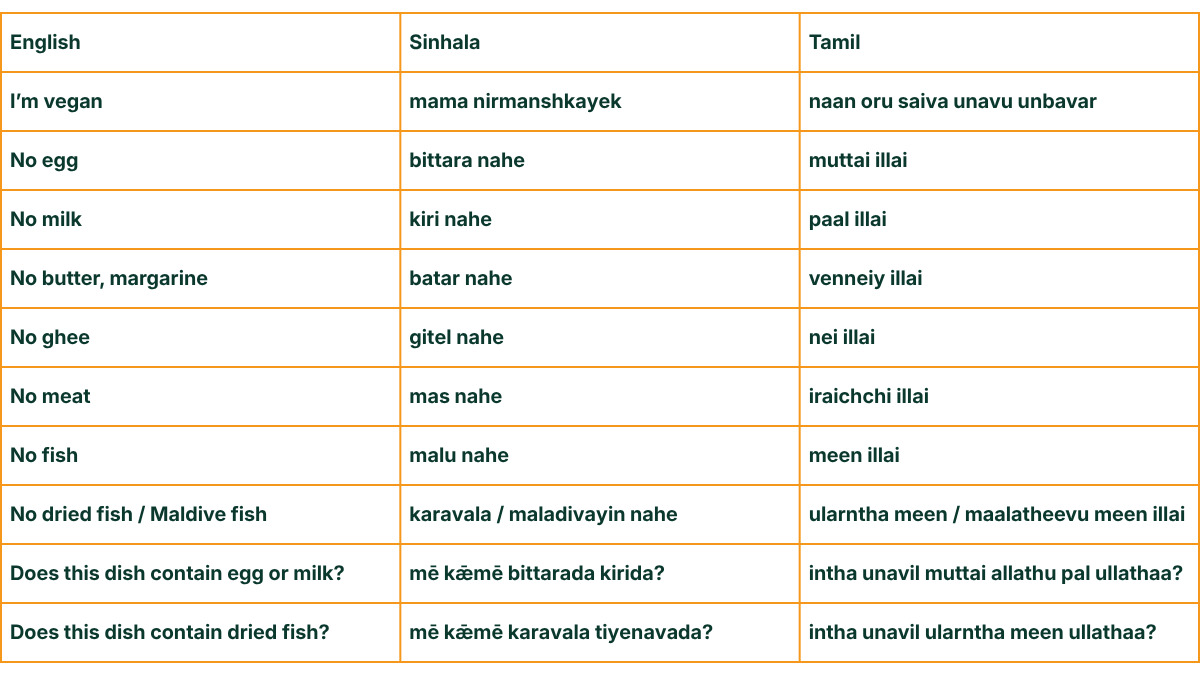
Especially if you have an allergy or severe intolerance, having the most important phrases in Sinhala or Tamil ready on your phone can be very helpful.
So, how easy is it really to be vegan in Sri Lanka?
In my personal experience: surprisingly easy.
You might not find a restaurant with "100% vegan" written on the door around every corner, and supermarkets do not have the same huge shelves full of vegan alternatives that you might be used to in Europe.
But they do not really need to.
Many of the foods and dishes eaten every day in Sri Lanka are already plant based or can very easily be ordered vegan.
Rice, lentils, coconut, vegetables, fruits and an incredible variety of spices are simply a natural part of Sri Lankan cuisine.
You really just need to know where animal based ingredients can sometimes hide and what to ask when ordering.
Once you know that, an incredibly diverse cuisine opens up to you.
And honestly?
I have never gone home hungry in Sri Lanka. 😉